Updated: 4/20/26
The 4/20 Files • Open Letter • Public Record • Book Audit
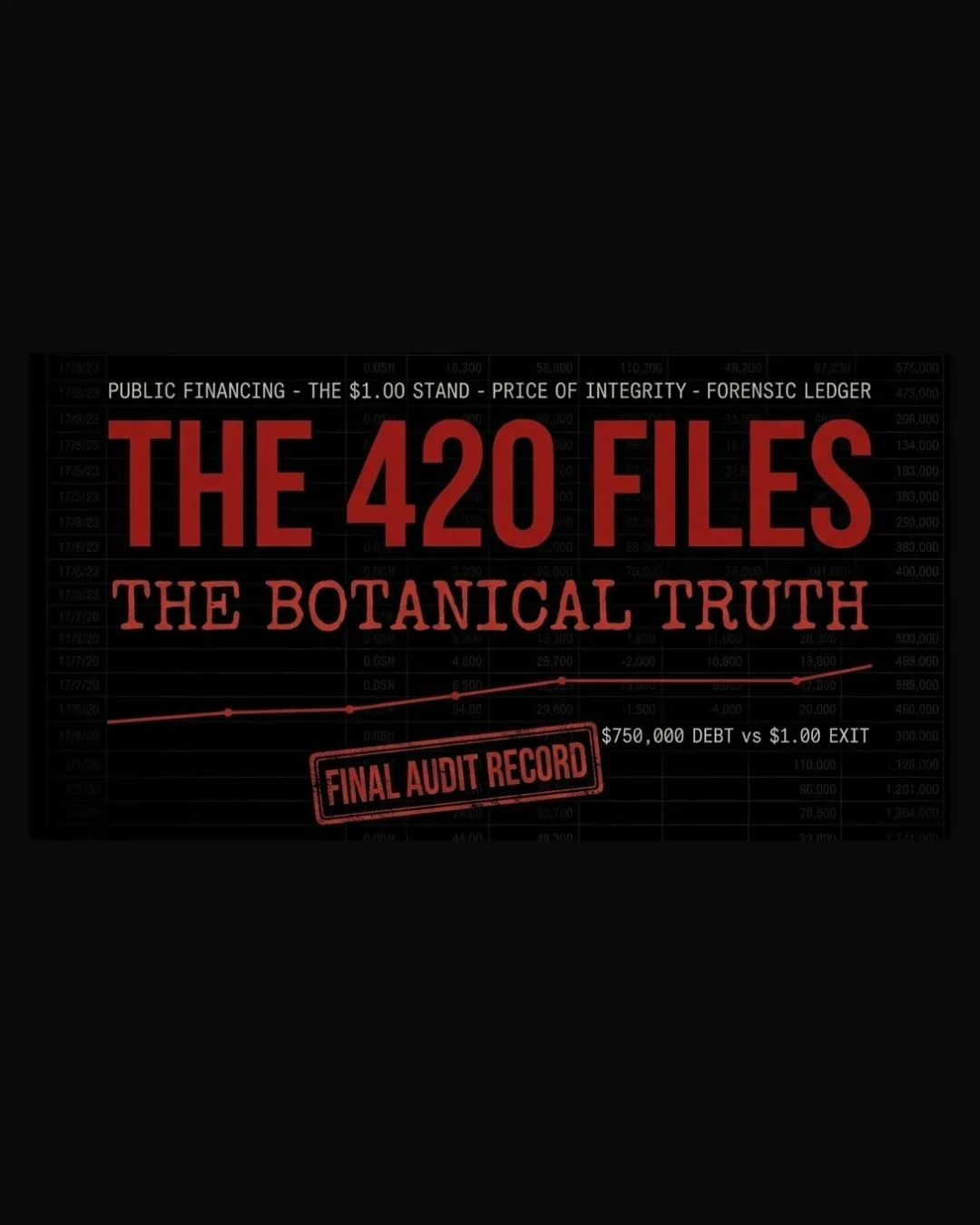
The 4/20 Files: The Botanical Truth
This page begins where the story begins: with the loss of a mother, the illness of a son, and a promise that natural relief should not be buried under noise, loopholes, or spectacle.
It moves from personal testimony into records that readers can inspect for themselves: federal enforcement actions, campaign-finance pages, and statutory text. The argument is direct, but the structure is simple.
The story is personal.
The records are public. The reader can decide what the audit proves.
What makes that record so devastating is the human cost behind it. Billions of dollars have been wasted in a pump-and-dump scheme while people searching for the benefits of real CBD were taken advantage of so others could profit from confusion, distortion, and financial gamesmanship.
Because of the people who helped perpetrate this, families and communities have paid the price in bankruptcy, broken friendships, lawsuits, divorce, hospitalizations, and even death.
I entered this industry for one reason.
To find a clean botanical option for my son when prescription medicine came with side effects and the market had not yet produced a product I trusted.
April 20 also marks the loss of my mother, which is why this date is not a marketing holiday to me.
It is a ledger entry in grief.
That is the moral center of this page. It is not a brand exercise. It is a father’s record of what he believed, what he built, what he walked away from, and what he believes happened to the ground beneath the Kentucky hemp industry.
It is also important for the reader to understand how simple the ask really is. We are not asking for some radical new right. We are asking to do what Americans, including the Founders, once did openly: grow cannabis sativa hemp as a legitimate agricultural crop and botanical resource.
For generations, that plant and its extracts were part of American life. Up until the federal government stepped in with the 1937 tax regime, cannabis extracts were common products in pharmacies, and hemp itself was understood as a useful crop with real agricultural and practical value.
That history matters because this page is not only about one modern betrayal. It is about the latest chapter in a much longer American story.
The central question is whether ordinary people still have the freedom to grow a plant that was cultivated, used, and understood long before political theater, donor games, and regulatory distortion took hold.
I came here as a father. What follows is a story about family, soil, public records, and the price of walking away when integrity costs more than money.
Open Letter • Public Record • Book Audit
TO THE JURY OF THE PEOPLE
This page begins where the story begins: with the loss of a mother, the illness of a son, and a promise that natural relief would not be buried beneath noise, loopholes, or spectacle.
From there, it moves from personal testimony to records any reader can inspect for himself: federal enforcement actions, campaign-finance filings, and statutory text.
The structure is simple because the truth does not need to be complicated. The story is personal.
The records are public. The reader is free to decide what the evidence proves.
And the evidence tells a story.
Behind the filings, the money, and the maneuvering were real people—families searching for relief, parents looking for answers, individuals trying to hold themselves together.
Instead, too many were pulled into a system built on confusion, distortion, and financial gamesmanship, where truth was buried and profit came first.
The cost was real. It was paid in bankruptcies, broken friendships, lawsuits, divorce, hospitalizations, and death.
So the question is not whether a story has been told.
The question is whether the record supports it.
The evidence is in front of you.
The record is public.
The consequences are real.
Now the judgment belongs to you.
I am $750,000.00 in debt from helping build this industry, while they made millions as the industry itself lost billions. I put everything on the line to build something real. They profited from the scheme while the people who believed in hemp were left carrying the cost.
And that is the question hanging over every section of this page: did any of that have to happen?
Personal Record • Historical Foundation
THE MORAL FOUNDATION
I entered this industry for one reason: to find a clean botanical option for my son when prescription medicine came with side effects and the market had not yet produced a product I trusted. April 20 also marks the day my mother died, which is why that date is not a marketing holiday to me. It is a ledger entry in grief.
That is the moral center of this page. It is not a brand exercise. It is a father’s record of what he believed, what he built, what he walked away from, and what he believes happened beneath the Kentucky hemp industry.
It is also important to understand how modest the ask really is. We are not demanding some radical new right. We are asking to do what Americans, including the Founders, once did openly: grow Cannabis sativa hemp as a legitimate agricultural crop and botanical resource. For generations, that plant and its extracts were part of American life. Before the federal government imposed the 1937 tax regime, cannabis extracts were sold in pharmacies, and hemp was widely understood as a crop with practical and agricultural value.
That history matters because this page is not only about a modern betrayal. It is about the latest chapter in a much older American story. The central question is whether ordinary people still have the freedom to grow a plant that was cultivated, used, and understood long before political theater, donor games, and regulatory distortion took hold.
We are simply saying: let farmers grow hemp. Let the plant be judged by its botanical truth, not by opportunists who profit from confusion. And let the public see clearly that government actors, lobbyists, and even some of the people who claim to be fighting for your rights are not always telling the full truth when money and outside interests are on the table.
This page exists to document that conflict. It is a record of what was lost, what was protected, and what must be reclaimed.
Integrity Audit
THE $1.00 STAND
My price for integrity.
I was there at the beginning, in 2014, before GenCanna. At the time, I had decided to work with GenCanna and another partner on a larger mission: to help bring real hemp cultivation opportunities back to Kentucky and build something rooted in the soil, not in hype.
But it did not take long for me to realize we were not building the same thing. I concluded quickly that our values, our purpose, and our understanding of the mission were fundamentally different.
So I sold my entire one-third stake in the company back for one dollar.
Truthfully, I wanted to pay them a dollar to take it back, but the lawyers said that would not work. My son’s health and my own integrity were not for sale.
Aftermath
WHAT CAME AFTER THE EXIT
Soon, GenCanna’s collapse became part of the larger Kentucky hemp cautionary tale.
What was sold to farmers, families, and communities as a bold future for Kentucky agriculture eventually unraveled into bankruptcy, unpaid obligations, and a deep erosion of trust. The wreckage did not fall on lobbyists or political performers. It fell on growers, contractors, and local people who believed they were helping build something honest and lasting.
On this page, the bankruptcy story matters because it is more than a failed company. It is an early warning about what happens when hype outruns truth, when commerce detaches from conscience, and when the people closest to the soil are treated as expendable. What followed was not just a business failure. It became part of a broader pattern of distortion, protection, and betrayal that would shape the Kentucky hemp story for years to come.
The one-dollar exit is not here for drama. It is here to establish the line I drew before the rest of the story unfolded. I walked away before the collapse because I understood we were not building the same thing. That moment matters because it shows that the conflict was visible early, and that some of us chose to step back rather than surrender our integrity to it.
Executive Orders • November 15, 2022 • State Stand-Down
Kentucky State Police Told to Back Down
In 2022, while farmers were fighting for the Botanical Truth, the state issued the order that told Kentucky State Police to back down. What was framed as relief functioned, from the soil up, as the first major state-sanctioned cover for the synthetic market.
In the "Hemp Hustle" timeline, the Executive Orders issued by Governor Andy Beshear in November 2022 serve as a pivotal moment where the state acknowledged the chaos of the "Miller Loophole." While these orders were presented as a win for "relief," from the perspective of someone working in the dirt, they provided the first major state-sanctioned cover for the synthetic market.
The Executive Orders of November 15, 2022
1. Executive Order 2022-790
The Regulation of Synthetic Delta-8
The Content: This order stated that Delta-8 THC products were not illegal under Kentucky or federal law, citing a Kentucky court ruling that blocked the Kentucky State Police and the Kentucky Department of Agriculture from raiding shops selling these products.
The Cover: The order directed the Cabinet for Health and Family Services to treat Delta-8 exactly like CBD. Labeling and packaging rules normalized lab-made isomers instead of drawing a hard line against them.
The KSP Impact: This functioned as a stand-down command to the Kentucky State Police. As long as a product claimed to be hemp-derived, law enforcement was pushed away from treating it as an illegal intoxicant.
2. Executive Order 2022-798
The Medical Cannabis Pardon
The Content: This order granted a full, complete, and conditional pardon to Kentuckians possessing small amounts of marijuana for medical reasons when it was legally purchased out of state and backed by receipts.
The Political Pivot: This was the grandstand moment. Attention moved away from the Botanical DNA of Kentucky farmers and toward a framework that rewarded out-of-state supply chains and lab-made slurries.
The Result: The message was not to protect the natural farmer. The message was that the political system would tolerate a market built around everything except Kentucky soil.
The Betrayal in Practice
Normalization of Synthesis
By ordering the state to regulate Delta-8 rather than ban it based on its lack of botanical DNA, the Governor gave the Hemp Hustlers a multi-year head start to build their synthetic bubble before the later crackdown.
The KSP Stand-Down
The Kentucky State Police were told to stop treating lab-made intoxicating chemicals as controlled substances. Beaker slurry moved from the shadows into checkout-counter displays while the state looked the other way.
Wasting the Farmer's Time
While synthetics were given regulatory cover, the natural farmer still faced the burn pile if a crop tested 0.4% or 0.9% THC. The chemist got a labeling requirement. The farmer got punished for biology.
"In 2022, while we were fighting for the Botanical Truth, the Governor signed an order that told the State Police to look the other way. He gave the Hustlers a permit to sell synthetic fraud as long as they put a sticker on the bottle. He called it progress. I call it the day the state officially traded the Kentucky farmer for the lab-made chemist."
Receipt Link: Executive Order 2022-790 – Regulating Delta-8
Forensic Audit Section
Public Financing and Political Context
Money is part of the narrative, but readers should not have to take my word for it. This section points directly to the committee pages so anyone can inspect the receipts, coverage periods, and donor patterns for themselves.
The Commodity Crash
90% DECLINE
While lobbying revenue surged, Jonathan Miller admitted in federal testimony that hemp commodity prices have plummeted, bankrupting Kentucky farmers.
The Frost Brown Todd Pipeline
$320,000 / YEAR
The U.S. Hemp Roundtable pays Jonathan Miller’s law firm, Frost Brown Todd LLC, roughly $320k annually to influence federal legislation.
The "Hustler" Tax Audit
IRS Form 990 filings reveal that the U.S. Hemp Roundtable operates as a 501(c)(4) funded by anonymous industry donors who profit from the synthetic "Miller Loophole."
Exhibit Locker: The 4/20 Files
Senator Rand Paul (The Actor)
FEC Committee: RAND PAUL FOR US SENATE
Cycle Receipts: $217,423.39
Coverage through March 31, 2026
Senator Paul acts as a "Legislative Heat Shield" for the U.S. Hemp Roundtable.
While Senator McConnell used the 2026 spending bill to finally close the "intoxicating loophole" (Section 781), Paul’s "Medical Freedom" brand is being used as a front to keep these toxic synthetics legal. He frames it as "liberty," but it’s actually a protection racket for a few lab-owners who maximize profit by avoiding the safety standards required of real medical or agricultural products.
Paul uses videos about "Natural Relief" to get veterans and chronic pain patients on his side.
Instead of supporting clean, tested, agricultural hemp (the kind KY farmers grow), his legislation protects "Total THC" products, chemicals that are often synthesized with toxic solvents like sulfuric acid or toluene.
By blocking federal safety standards in favor of "self-regulation" by his donor-led groups (The Roundtable), he ensures that "Natural Relief" stays dangerous, giving the entire industry a black eye while his PAC stays flush with cash.
Rep. Thomas Massie (The Outsider)
FEC Committee: MASSIE FOR CONGRESS
Thomas Massie uses his "Shire" homestead and anti-establishment rhetoric as a smokescreen for his role as the House’s primary defender of the synthetic cannabinoid industry.
While he claims to represent Kentucky's small farmers, his primary legislative push in late 2025 (H.R. 6209) was a direct attempt to repeal Section 781—the very safety provision meant to stop toxic, lab-made synthetics from being sold as "hemp."
-
Massie sells the same "Medical Freedom" brand as Paul, but for smaller lobbyist checks. It shows that the "Outsider" image is actually a high-margin business.
-
The Fact: Massie’s 2026 FEC filings show over $1 million in receipts, with a significant portion of his "Other Committee" (PAC) money coming from the same PhRMA (Vaccine Lobby) and US Hemp Roundtable connections that fund the "establishment" he claims to fight.
- On November 20, 2025, just as the government was closing the synthetic loophole, Massie introduced H.R. 6209 to repeal the ban.
- This wasn't about fiber or grain farmers. It was about protecting the $5 Billion synthetic intoxicating oil market.
- Like Paul, Massie’s bill is "Intro-Only"—it’s designed to die in committee, providing him the "Liberty" talking points to show his donors at the Roundtable while the actual farmers in his district continue to struggle with a crashed market.
Exhibit D: The $100 Million Banking "Flush"
While Grandstanders performed for cameras, their preferred bankers facilitated a "Pump and Dump" engine room.
Download Federal Enforcement Record
The Farmer gets the Bankruptcy. The Lobbyist gets the Check.
I sold my third of GenCanna for $1.00 because my integrity isn't for sale. Jonathan Miller stayed for the 90% crash.
The Truth is in the Ledger.
The Truth is in the Ledger.
I carried $750,000 in debt to keep the Botanical Truth alive. They raised millions to bury it.
"37th Parallel" – The Forensic Audit of a 12-Year Betrayal